Rochefort
The Three MusketeersRochefort is the scarred stranger first encountered by d'Artagnan at the Jolly Miller and later identified as a trusted agent of Cardinal Richelieu. His importance lies not only in his direct hostility toward d'Artagnan, but in the way his movements join the novel’s apparently separate worlds: provincial insult, court politics, international intrigue, secret letters, and the rival power networks surrounding the king and the cardinal. He is at once a recognizable individual and a concealed function within political authority, a man whose identity is repeatedly displaced into disguises, reports, and names.
Identity and First Appearance
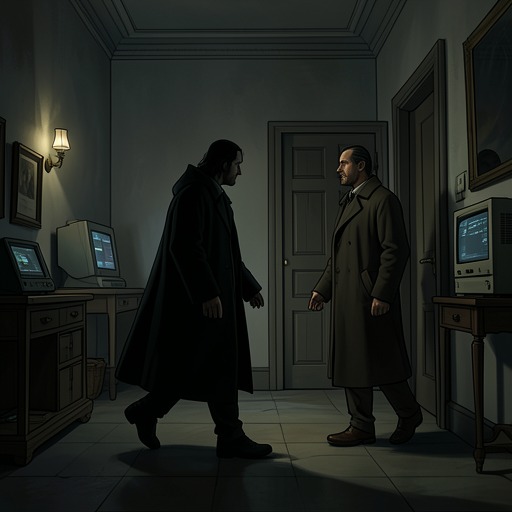
Rochefort enters the story as the gentleman in the violet doublet whom d'Artagnan observes through an open ground-floor window at the Jolly Miller. He is between forty and forty-five, with black, piercing eyes, a pale complexion, a strongly marked nose, and a well-shaped black mustache. His clothing is plain but carefully noted: violet doublet and hose, matching aiguillettes, and the creases of garments that have spent a long time packed for travel. The detail of the clothing makes him look both cultivated and mobile, a gentleman whose appearance bears the marks of continuous movement.
The narrator gives this physical description through d'Artagnan’s unusually rapid scrutiny. The young Gascon instinctively senses that the stranger will exert a powerful influence over his future, even before he knows the man’s name. That intuition turns the encounter into more than a tavern quarrel. Rochefort is first perceived as an object of attention, then as an insult, and finally as a continuing presence whose significance exceeds the immediate scene.
Rochefort’s initial behavior is calculated to provoke. He discusses the qualities of d'Artagnan’s Bearnese pony with two listeners who hold him in evident respect, and his remarks produce repeated laughter. When Rochefort permits a pale smile to accompany one of his observations, d'Artagnan becomes convinced that the mockery is deliberate. The young man approaches with one hand on his sword and the other on his hip, intending to deliver a lofty challenge but finding only a gross personal insult. Rochefort therefore becomes the first figure through whom d'Artagnan’s pride, impulsiveness, and desire for recognition are tested.
The Man of Meung and the Chain of Rumor
The stranger escapes before d'Artagnan can settle the matter, leaving behind an unresolved grievance and a set of clues. The Jolly Miller’s host reports that, during the disturbance, the man referred to Monsieur de Treville and declared that they would see what Monsieur de Treville would think of the insult offered to his protégé. The pocket he touched contained a letter addressed to Monsieur de Treville, captain of the Musketeers. The letter makes Rochefort’s encounter with d'Artagnan part of a larger network: the stranger is not merely a passing traveler but someone who knows the institutions and names that govern d'Artagnan’s ambitions.
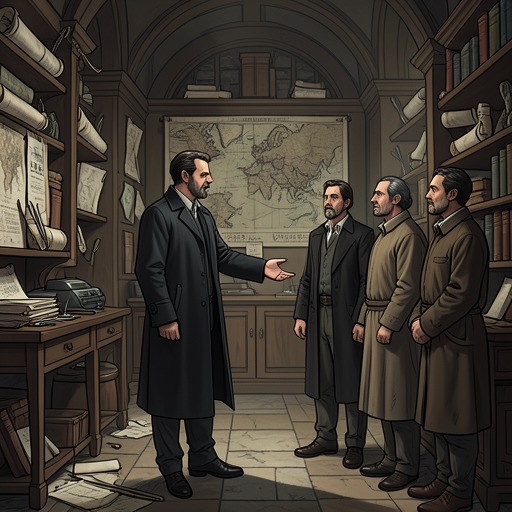
When d'Artagnan reaches Monsieur de Treville, the captain recognizes the description of the man from Meung. Rochefort has a slight scar on his cheek, apparently made by the grazing of a ball, and Treville immediately treats him as a danger rather than an ordinary adversary. Treville warns d'Artagnan that if he sees the man on one side of the street, he should pass on the other, because Rochefort would break him like glass. The warning enlarges Rochefort’s reputation while withholding a complete explanation of it.
The identification remains connected to another concealed figure. When d'Artagnan reports that the stranger had been accompanied by a woman called Milady, Treville murmurs that it must be the same man and says that he had believed him still to be at Brussels. Rochefort is thus linked from the beginning to Milady the English spy, Brussels, and the international movement of political agents. D'Artagnan’s immediate response is to demand the stranger’s identity and origin so that he can avenge himself, even offering to abandon his hope of admission to the Musketeers. Treville’s refusal to reveal everything preserves Rochefort as a forbidden object of knowledge and redirects d'Artagnan toward the discipline of proving himself.
Political Function and Disguises
Rochefort’s political role becomes clearer through the reports circulating among the Musketeers. In an account of the Chalais conspiracy, an esquire is said to have met Rochefort at Brussels disguised as a Capuchin. In that disguise, Rochefort had deceived Monsieur de Laigues. The episode confirms that his methods depend on mobility, impersonation, and the exploitation of appearances. The disguise is not an incidental trick but a practical extension of his identity: Rochefort operates where official power needs deniability and where information must cross borders without openly declaring its source.
The Musketeer who tells the story calls Rochefort the Cardinal’s âme damnée, marking him as an instrument of Cardinal Richelieu’s will. The phrase places Rochefort below the visible office of the cardinal but close to its effective violence. He is the agent who can travel, deceive, observe, and interfere while the political authority behind him remains partially removed from the scene. His relation to Richelieu therefore explains why Treville treats him as a danger greater than d'Artagnan’s youthful courage can safely confront.
Rochefort’s appearances also demonstrate how the narrative turns political intelligence into a form of suspense. His name surfaces in conversation, his scar confirms an earlier description, and his movements are reconstructed through reports from Brussels and Meung. The reader learns him by accumulation rather than confession. Each fragment makes him more concrete while preserving the larger question of what he is doing and for whom. The effect is a portrait assembled from physical evidence, hearsay, and institutional fear.
Conflict with d'Artagnan and Narrative Role
For d'Artagnan, Rochefort is the original personal enemy: the man who laughs at his horse, provokes his pride, escapes his challenge, and then becomes the hidden object of his pursuit. The quarrel gives emotional form to d'Artagnan’s entrance into the wider world. His ambition to become a Musketeer is initially entangled with the wish to avenge an insult, and Rochefort becomes the figure against whom youthful bravado must measure itself.
Their opposition is also a conflict between two kinds of movement. D'Artagnan travels openly, carrying a letter of recommendation from Monsieur de Treville and declaring that he will guard it so carefully that anyone who attempts to take it will regret the attempt. Rochefort travels through disguises, rumors, and political assignments. One seeks recognition by displaying his name and courage; the other gains power by concealing his identity and purpose. The contrast makes Rochefort a threshold guardian in d'Artagnan’s early trajectory: he embodies the dangerous, already politicized world into which the young Gascon is trying to enter.
The narrative’s documentary imagination reinforces this role. The preface claims that the story derives from written records, including a manuscript titled “Memoirs of the Comte de la Fere, Touching Some Events Which Passed in France Toward the End of the Reign of King Louis XIII and the Commencement of the Reign of King Louis XIV.” The search for Athos, Porthos, and Aramis gives the novel an archival frame, while Rochefort’s identity is likewise mediated through letters, testimony, and remembered encounters. Even the political crisis surrounding Anne of Austria’s letter is presented through a document whose contents alter the king’s understanding of the queen’s conduct. In this world, paper and rumor do not merely describe power; they transmit it.
Significance and Later Reversal
Rochefort’s decisive significance is that he begins as an unexplained aggressor and develops into the human face of a larger political system. The man in the violet doublet is not simply a duelist who happens to serve the cardinal. His disguises, foreign movements, association with Milady, and reputation as Richelieu’s devoted agent establish a pattern in which private encounters are always liable to reveal state business beneath them.
The early narrative presents him as an almost insurmountable adversary, and Treville’s warning makes that danger explicit. Yet the later political world is capable of reversals. When d'Artagnan presents Richelieu with the precious paper that Athos had forced from Milady and then entrusted to him as a safeguard, the young man confronts the cardinal through documentary evidence rather than through the impulsive swordplay that first brought Rochefort into his life. Rochefort’s importance can therefore be measured by the change he helps dramatize: d'Artagnan’s passage from pursuing a mysterious man in anger to navigating the secrets, papers, and powers that shape the court.
Rochefort remains memorable because the narrative never reduces him to a single social label. He is the stranger, the man of Meung, the scarred traveler recognized by Monsieur de Treville, the disguised operative reported at Brussels, and the Cardinal’s âme damnée. These identities are not interchangeable decorations; together they create a figure whose personal mystery is inseparable from the novel’s larger concern with concealed allegiance, political surveillance, and the unstable boundary between honorably declared action and covert power.